
Sumter Parole and Probation
Parole and probation both allow a person to live in the community under rules, but they begin in different ways. A South Carolina court orders probation. It may replace a jail or prison term, or it may follow a period of confinement. The South Carolina Board of Paroles and Pardons grants parole to an eligible state prisoner. Parole permits the balance of an SCDC sentence to be served under community control. A parole grant is not the same as the date a person leaves prison.
The South Carolina Department of Probation, Parole and Pardon Services, known as DPPPS, supervises both groups. It also tracks statutory categories such as community supervision, supervised reentry, and supervised furlough. A DPPPS result identifies the supervision category at the agency's snapshot. It does not establish which Sumter County facility held the person or the exact time custody ended.
| Point | Parole | Probation |
|---|---|---|
| Who orders it | South Carolina Board of Paroles and Pardons | Sentencing court |
| Prior prison term | Follows an eligible SCDC prison term | May occur without state imprisonment |
| Public verification | DPPPS search, Board hearing record, and SCDC release record | DPPPS search and the Sumter court order |
| What ends it | Formal discharge, expiration, or other agency action | Court or agency completion and discharge |
- Discharge
- The formal end of a sentence or supervision term.
- Absconder
- A supervised person alleged to have stopped reporting or left supervision without permission.
- Detainer
- A request by another authority to hold or take custody of a person.
- Supervised reentry
- A South Carolina post-prison control category distinct from ordinary parole.
Check Sumter Post-Release Supervision
The official DPPPS Offender Search is the first public check. Its fields include first name, last name, SID, county, and year of birth. Valid combinations include first and last name, SID alone, a name with birth year, or county paired with a name or SID. Use the SID when available. It is more reliable than a common name.
DPPPS states that its public display reflects the prior day. Someone whose supervision changed today may still show the old category. A person who completed supervision may disappear from the results. For that reason, a no-result cannot prove there was never Sumter County post-release supervision.
- Match the person to an SCDC ID, SID, date of birth, or Sumter court case number.
- Search DPPPS with the narrowest valid field combination and note the displayed category.
- Compare a prison release to the SCDC Released Inmate Search, including its exact release type.
- Read the Sumter sentence or probation order to learn which court imposed control.
- Call the Sumter DPPPS office for a same-day or past-status question the public snapshot cannot settle.
The DPPPS supervision lookup shown here provides the official public search route.
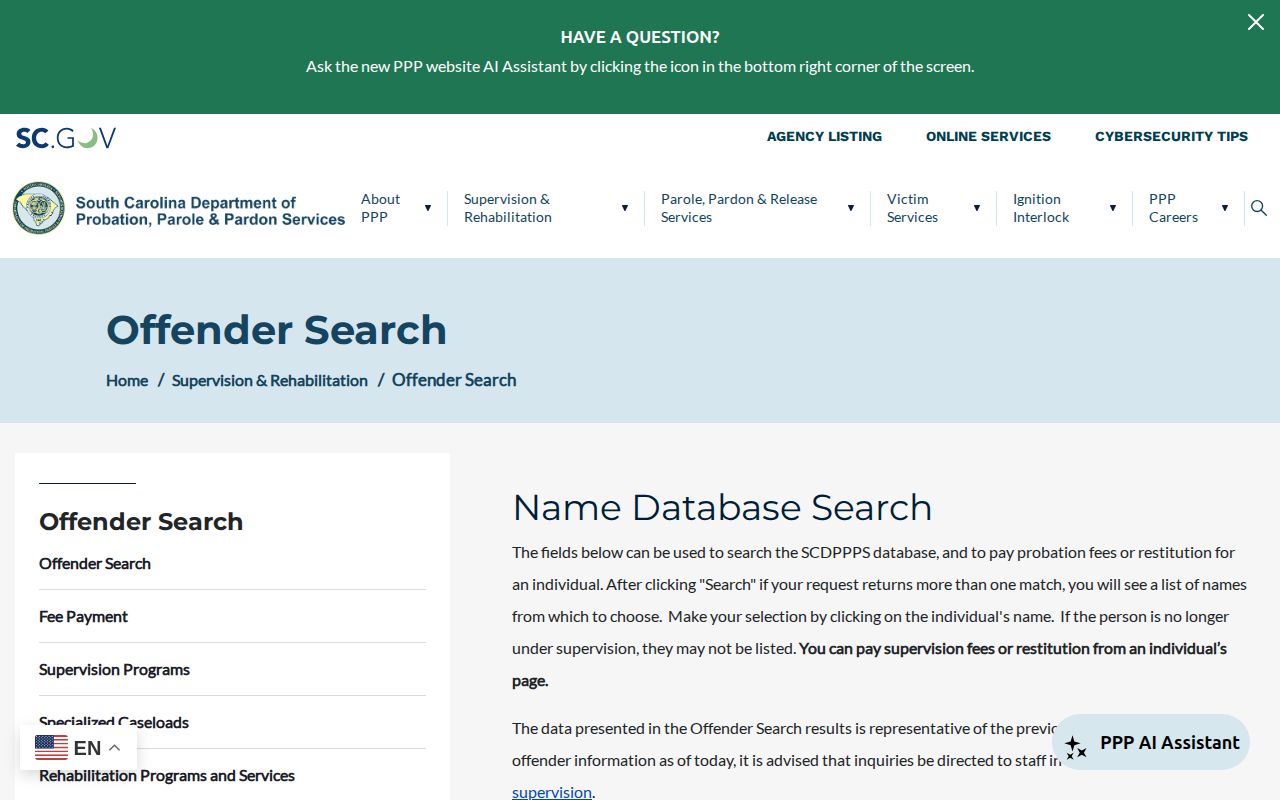
Its prior-day timing makes the local office an essential second channel for recent changes.
Note: Record the access date and exact category because a live supervision result can change after discharge or agency action.
Sumter Supervision Office Records
Sumter County has a named DPPPS office. The office listing separates parole, probation, community supervision, supervised reentry, and other categories in its local counts. Those totals are changing snapshots, so they should not be treated as permanent statistics. The office is the practical fallback for a current status or a past term that no longer appears online.
South Carolina DPPPS, Sumter County20 N. Magnolia Street
Sumter, SC 29150
Mail: P.O. Box 1322, Sumter, SC 29151
Phone: 803-778-5185
Fax: 803-775-3653
When calling, provide stable identifiers and ask a precise question. Useful wording is: “Does the record show current supervision, which category applies, and what date did that status begin or end?” Staff may limit details, but the focused request avoids confusing parole with court-ordered probation.
The official Sumter County office listing confirms the office details pictured below.
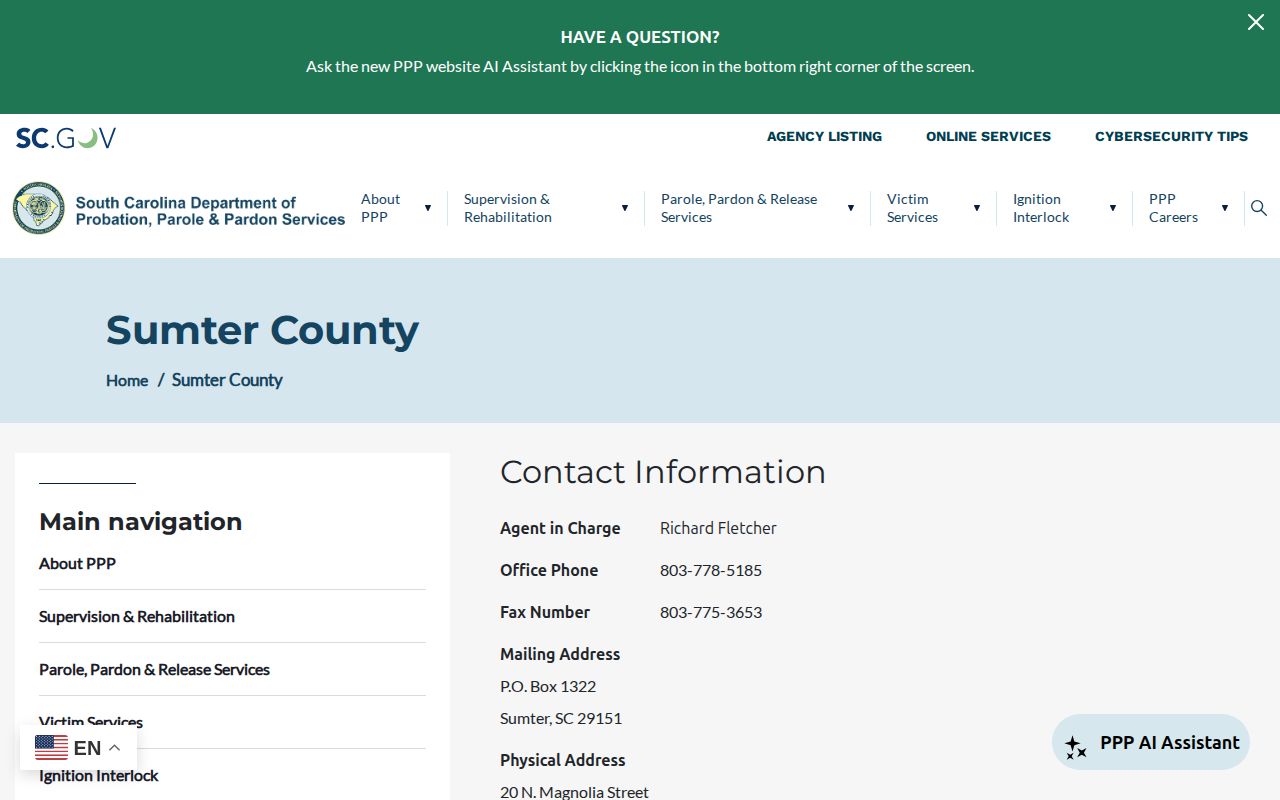
This local contact is especially useful when the public search has not caught up or no longer retains a completed term.
Sumter Supervision Release Chain
A complete answer often uses three records. For a state-prison exit, the SCDC Released Inmate Search documents the corrections event and its release type. The DPPPS record addresses community control. The Sumter sentence sheet or filed order explains the legal basis. Together, those sources distinguish physical release, supervision, and final discharge.
County detention follows a different route. A person can receive probation without entering SCDC, so there may be no SCDC released row. Begin with the Sumter court order and the Sheriff's release record, then use DPPPS. The full county-jail search and release-record path is covered on the Sumter County released inmates lookup. A transfer from the detention center to SCDC is continued custody, not post-release supervision.
Sumter Parole Hearing Records
The seven-member South Carolina Board of Paroles and Pardons may grant or deny parole and may revoke, modify, or rehear it. Its hearing schedule and results search accepts first and last name, SCDC number, a name with a month, or a month alone. DPPPS says dates become final about 30 days before a hearing, and later delays or rescheduling can occur.
A posted grant is an important decision, but it does not prove the person has walked out of an institution. Implementation can take time, and another hold may affect the path. Confirm the later event in the SCDC released database. If the result is a denial, agency materials state that another hearing may take place in one or two years, depending on the offense date and classification.
The Board can also revoke, modify, or rehear parole. Those actions concern legal supervision status and should be read from the current Board or DPPPS record. Do not build a generic set of result labels that the live system does not show. Preserve the posted wording, the hearing date, and the date the result was accessed.
Parole eligibility is sentence-specific. Under South Carolina Title 24, Chapter 21, Section 24-21-610 generally uses one-third of a term up to 30 years, or ten years for life or a term above 30 years, with distinct rules for violent crimes and statutory minimums. Section 24-13-100 separately defines no-parole offenses. An official hearing search is safer than a personal date calculation.
Note: A hearing result records a Board decision; the SCDC release record is the stronger source for the later prison exit.
Sumter Supervision Violations
Supervision conditions are the rules attached to release or a court sentence. They can include reporting, approved travel, payments, programs, or conduct terms stated in the person's order. The exact conditions come from DPPPS and the controlling court or Board document. Do not infer them from a general category shown online.
A violation allegation can lead to agency action, a warrant, a hearing, or renewed custody. An absconder is a person alleged to have stopped reporting or left control without permission. Yet failure to appear in the public DPPPS search is not evidence of absconding. The name may be misspelled, the snapshot may lag, or the supervision term may have ended. No official Sumter-specific public absconder list was found.
For a warrant question, contact DPPPS or the issuing court and law-enforcement custodian. SC VINE may provide notice of a custody or supervision status change from a participating system, but it is an alert service rather than a certified warrant record. Use the supplying agency shown in VINE before drawing a conclusion.
Property After Sumter Release
Local property rules can matter after supervision starts. The Sumter detention FAQ says valuables or property require an inmate-signed authorization. Pickup occurs at 1250 Winkles Road from 11 a.m. to 1 p.m., Monday through Friday. Those hours differ from the detention center's general public hours, so confirm the authorization before traveling.
A state-prison record issue follows a separate path. SCDC directs public-search discrepancies to Ombudsman@doc.sc.gov and sentence-calculation questions to Inmate Records at 803-896-8531. DPPPS cannot replace the jail or SCDC as custodian of those records. The supervision office handles supervision facts, while the releasing agency handles property, movement, and sentence calculations.
This division of responsibility prevents a common delay. Ask the office that created the record. Then give the DPPPS agent any corrected identifier needed to reconcile the supervision file.
Ending Sumter Post-Release Supervision
Supervision ends through formal agency or court action, not merely because a name vanishes online. A discharge closes the active term. Probation may end under the sentencing order and court process. Parole and other state release categories end under the governing sentence and DPPPS record. A new custody event or violation can alter that path.
For durable proof, ask for the discharge date and the document or record that states the term ended. Compare it with the sentence sheet and any SCDC release entry. If the online DPPPS search returns nothing, the Sumter office can explain whether the public system omits completed supervision and where a historical record request should go.
Keep the exact status wording. “Parole,” “probation,” “community supervision,” and “supervised reentry” are not interchangeable. The category affects which order controls and which office can confirm completion.
Note: A no-result is source-specific; it does not prove that no past Sumter County supervision record exists.